AOSK Steers a Bold Shift in Resource Mobilization for Religious Institutions
As part of the ongoing efforts to strengthen institutional resilience, the Resource Mobilization
Department, together with the Monitoring, Evaluation, Accountability and Learning (MEAL)
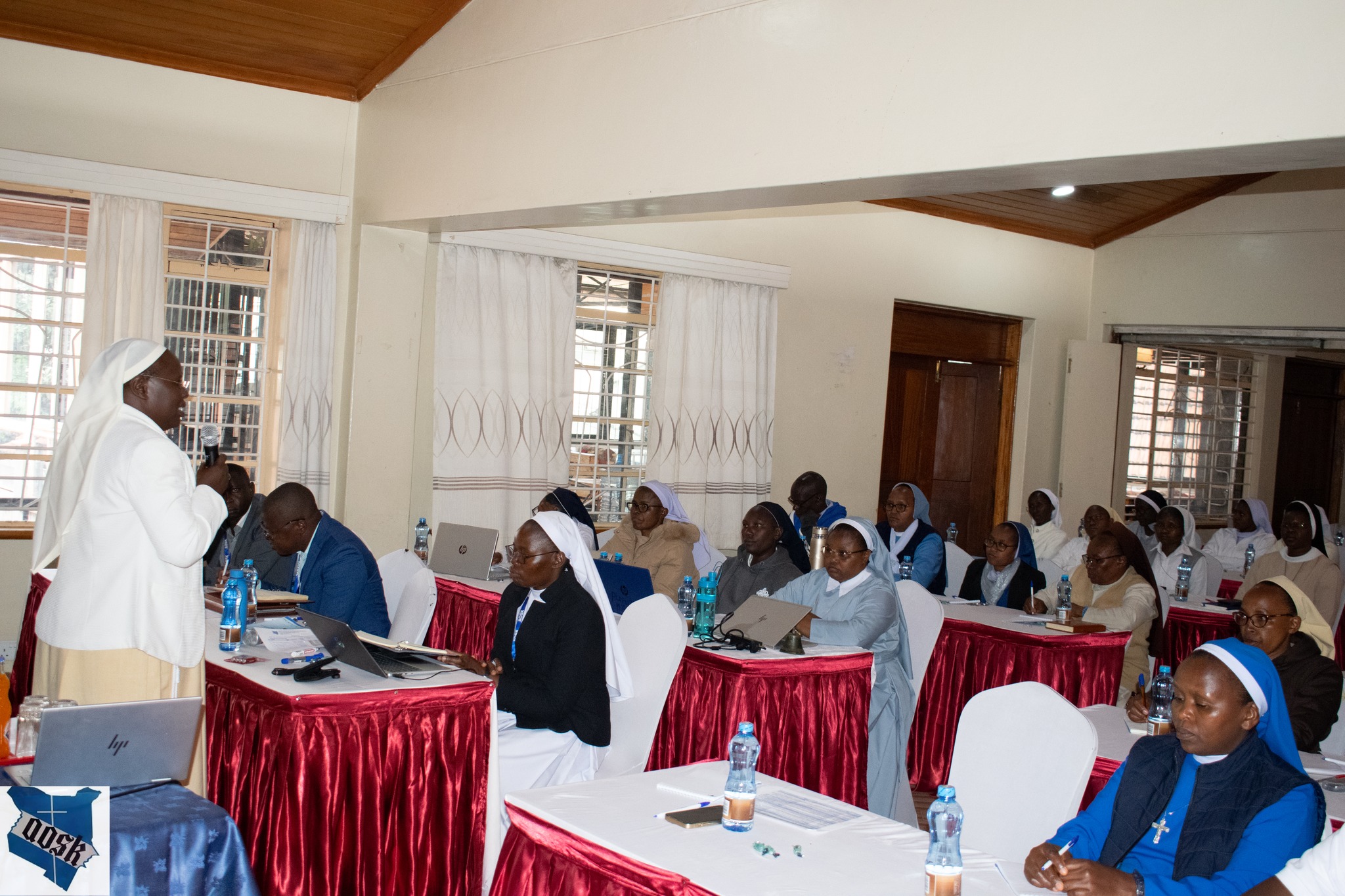
Department of the Association of Sisterhoods of Kenya (AOSK), organized a three-day training
aimed at equipping religious congregations with practical skills to navigate a rapidly changing
funding landscape.
The training held at Savelberg from March 17 to March 19 was officially opened by Sr Pasilisa
Namikoye, AOSK Executive Secretary, whose remarks set a reflective and forward-looking tone
for the sessions that followed.
A Call to Rethink Sustainability
In her opening address, Sr. Pasilisa underscored the urgency of rethinking traditional approaches
to funding and sustainability. She noted that the initiative builds on a journey aimed at
strengthening the association’s mission to support congregations in becoming more sustainable
and independent.
“We started this journey last year to strengthen the association’s mission to assist members to
remain sustainable and independent,” she said.
She emphasized that institutional strengthening and sustainability remain central to the
association’s strategic priorities, particularly as congregations continue to implement programs
aligned with the Church’s mission.
“We work for and in the Church and therefore our mission must be aligned within the Church so
that we carry out all the mandates within the Church,” Sr. Pasilisa added.
Shifting Mindsets in a Changing Funding Landscape
A key message from her remarks was the need for a mindset shift. She challenged participants to
move away from the assumption that funding is readily available elsewhere, particularly from
traditional donor regions.
“I know as you come to sit here, your mind might be thinking there is money somewhere in
Europe, there is money in the US. Unfortunately, they are also looking for money elsewhere,”
The Executive Secretary observed.
Drawing from her recent experience, she added, “We from Africa think they have money and
they were actually there trying to look for money elsewhere. Tutatafuta pesa wapi? (Where shall
we look for money?)”
This reflection set the stage for deeper discussions throughout the training, encouraging
participants to explore local solutions and maximize available resources.
Exploring Strategies for Long-Term Sustainability
The training highlighted the importance of leveraging existing resources and exploring
innovative strategies to ensure long-term sustainability. The Executive Secretary encouraged
congregations to think beyond traditional donor funding and consider investment and social
enterprise as viable pathways.
“The little we have at our disposal, we need to look for a way on how to increase the returns…
what are the strategies that we can use to increase for the next 30 years so that our congregations
remain strong,” she said.
She also pointed out the limitations of over-reliance on proposal writing, noting that success
rates remain low for many organizations. She underscored, “Some of us work in the development
office. That you have been writing proposals and out of twenty (20), you get one (1), what does
that mean? That we can look elsewhere… that we can become a little bit business oriented.”
Balancing Mission and Sustainability
While encouraging innovation, Sr. Pasilisa stressed the importance of aligning sustainability
efforts with the core mission of serving communities. She highlighted the need for congregations
to first ensure their own sustainability before extending support outward.
“They say charity begins at home. Are we going to give back when our own communities don’t
have? No, we have to ensure that our communities are sustainable.”
This perspective reinforced the idea that sustainability is not separate from mission, but rather a
foundation for its continuity.
Key Areas Covered During the Training
Over the three days, participants engaged in a comprehensive program designed to build both
strategic and practical capacity.
Participants explored foundational strategy and planning, core fundraising techniques, and
proposal writing. The sessions also addressed donor strategies and emerging trends, helping
participants better understand the evolving funding environment.
Proposal writing, identified as a major challenge in donor mobilization, was given particular
attention. Through practical sessions, participants were guided through initial proposal template
guidelines, enabling them to translate theory into actionable skills.
The training introduced participants to Monitoring and Evaluation within the context of religious
apostolate, breaking down key tools and frameworks. It also emphasized the integration of
MEAL into resource mobilization, demonstrating how data and impact can strengthen proposals
and build donor confidence.
Participants were equipped with skills to align budgeting with resource mobilization efforts,
ensuring financial accountability and effective management of resources. Recognizing the
growing role of technology, the training explored digital fundraising as a tool for expanding
reach and diversifying income streams.
The sessions concluded with group-based proposal follow-up discussions and project reporting,
allowing participants to refine their ideas, strengthen their proposals, and enhance their reporting
capabilities.
AOSK Commitment to Accompany Implementation
As the training concluded, the central message remained clear: sustainability requires intentional
action, strategic thinking, and a willingness to adapt. Sr. Pasilisa expressed confidence in the
collaborative approach taken during the training, encouraging participants to actively contribute
and learn from one another.
“I hope this training will be as participatory as possible so that what you know and what we
know we put together so that there may come something out of it,” she said.
With a strong foundation laid across resource mobilization, MEAL, financial management, and
innovation, participants are now better equipped to strengthen their institutions and sustain their
mission in an increasingly uncertain funding landscape.
In line with its mission, AOSK will conduct continuous follow-ups, mentorship, and technical
support, working closely with institutions to ensure that the knowledge and skills gained are
translated into practical action. This sustained engagement is aimed at strengthening systems,
reinforcing accountability, and ensuring that the impact of the training is not only visible but
deeply rooted within individual congregations as they grow towards greater sustainability and
resilience.
By AOSK Communications